


Breakthrough Aerodynamics Is Boxy Ford Flex’s Secret Weapon for Fuel Economy
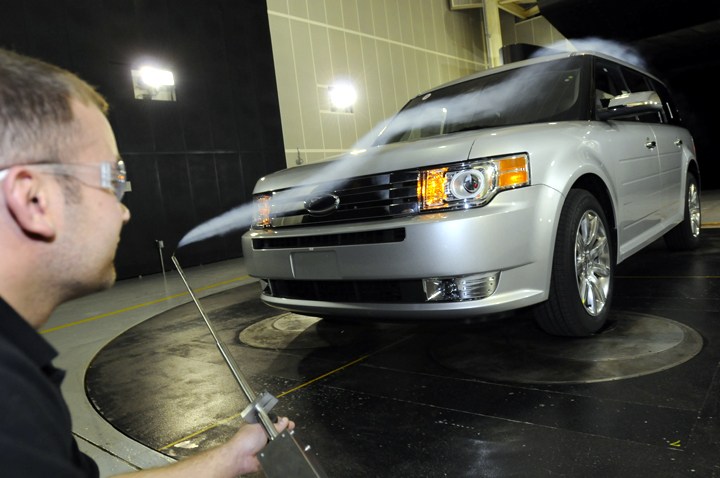 Ford Flex at Ford's wind tunnel. Here, 80-mile-per-hour winds are blown over the vehicle's silhouette. |
DEARBORN, MI - July 16, 2008: There's no doubt the 2009 Ford Flex's unique profile turns heads on the road, but can a boxy crossover vehicle really deliver the superb aerodynamics needed for maximum fuel economy?
In the case of the Flex, the answer is an unqualified yes.
 |
Compared to the competition, Ford Flex moves through the air with surprising ease.
At 55 mph, the Flex needs only 8.90 horsepower while the nearest competitors in the full-size crossover segment - the GMC Acadia and Toyota Highlander - require more than 9.30 horsepower. Moreover, the Flex's coefficient of drag is significantly better than all of its Asian competitors. Flex tests at 0.355 coefficient of drag while the competitors are at 0.375.
The Flex's standout aerodynamics equates to one mile per gallon improvement in fuel economy. Overall, the Flex achieves 24 miles per gallon on the highway and 17 miles per gallon in city driving.
 Rich Gresens, Ford Flex chief designer |
"The overall design of this vehicle, from its low-riding stance to its box-like body shape has actually worked to our aero advantage," Koester said. "Its low coefficient of drag amounts to significant gains in fuel economy."
Adds Rich Gresens, Ford Flex chief designer: "Flex was designed to shatter today's image of the common people mover, and our aerodynamic performance and fuel economy add to the list of Flex features that help set the vehicle and Ford apart in the marketplace."
Thinking outside the box
Flex designers and engineers made multiple design tweaks and ran
hundreds of tests, in the digital realm and in the Drivability Test
Facility's Wind Tunnel No. 8.
"We faced a unique challenge with Flex because the basic prototype design and unique body shape had generated so much positive appeal and interest early on that we didn't want to do anything radical like change the shape of the roof or the rear - design cues that were inherently Flex," Koester said. "We had to look for more subtle, detail changes that could reduce drag."
A surprise discovery for the team was that Flex's more square-shaped design cues - such as the front bumper sweep and headlamps - improved Flex's aero performance. In fact, the initial Fairlane show vehicle had more curvature and rounded areas on the exterior.
"We actually gave elements like the front bumper sweep, the roof, headlights more square dimensions to see if we could get better aero performance in the wind tunnel, and we did," Koester said.
Wind tunnel testing resulted in slight changes to the shape of the front air dam below the front fascia to reduce air flow under the car. Radius changes to the rear header - where the rear window on the liftgate meets the roof - were also optimized for less drag. Tail lamps were given a more rounded shape. Combined, these changes resulted in a .02 coefficient of drag reduction.
Also, cooling drag, the penalty associated with air going through the radiator, was minimized by blocking off the top third of the grille, forcing the air to glide over the outside of the vehicle.
Low Rider
One of the most intriguing features of the Flex is its wide, low-riding
stance, which gave the aero team a little wiggle room to play with ride
height - a major factor in a vehicle's aerodynamic performance. "The
underbody creates a lot of drag so the closer the vehicle body is to the
ground, the more airflow goes over the top, creating less drag," said
Koester.
Flex's unique design allowed the team to lower the ride height by almost an inch for a ground clearance of 130 millimeters - the standard for most Ford cars. This inch equates to a .015 coefficient of drag reduction.
"The aerodynamic nature of the Flex proves that sometimes you have to look beyond the standard," said Mike Kipley, supervisor of Vehicle Engineering. "From the beginning, Flex has inspired us to think outside the box. Now customers are reaping the benefits with a fuel-efficient people mover that dares to be different."