


Karl Benz, The Man Behind Mercedes-Benz +VIDEO
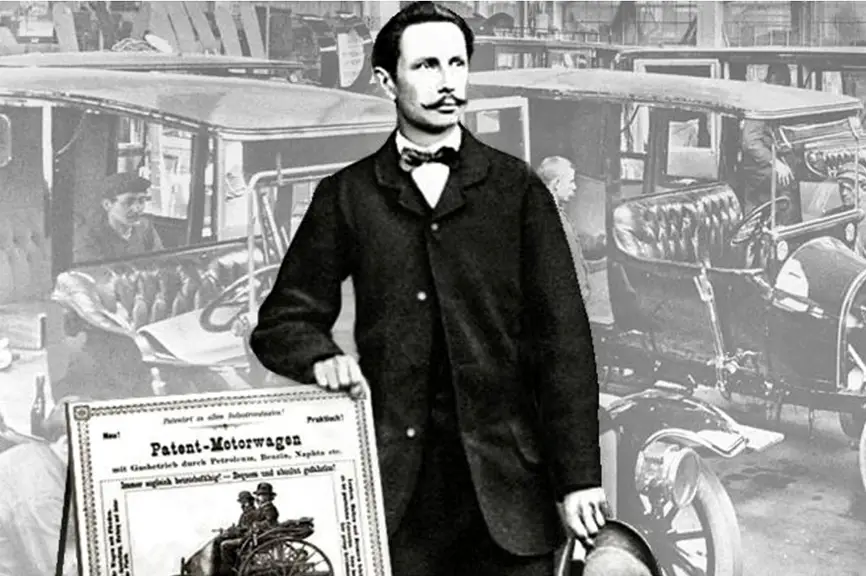 Karl Benz |
Biography Of Karl Benz
Karl Benz* was born on November 25, 1844 in Karlsruhe where he also grew up, went to school and subsequently studied at the polytechnic. After completing his studies, Benz worked first as an intern at Maschinenbau-Gesellschaft (a mechanical engineering company) in Karlsruhe and then as a design engineer in Germany and Austria. In 1871, he founded his first own company in Mannheim, an iron foundry and mechanical workshop. In the following year, he married Bertha Ringer with whom he had five children: Eugen, Richard, Klara, Thilde and Ellen.
Alongside mechanical engineering, Benz soon discovered a new field of activity for himself, the development of engines, and as early as 1879 his factory presented an operational two-stroke engine. However, Benz left the company, meanwhile converted into a stockholding company, as early as 1883 because he had had too little scope for decisions on technical developments.
In the fall of 1883, Karl Benz established a new company, “Benz & Co. Rheinische Gasmotoren-Fabrik” (Rhenish Gas Engine Factory) in Mannheim and turned his attention to the design of a vehicle to be driven by an internal combustion engine. In 1886, he was granted a patent on this “Motor Car” which he presented to the public the same year.
The inventor’s wife, Bertha Benz, used the third version of this motorized three-wheeler for her famous long-distance journey from Mannheim to Pforzheim in 1888. With this courageous trip, which also took her through Ladenburg, the energetic lady and her sons demonstrated the reliability of her husband’s motor car.
By 1890, Rheinische Gasmotoren-Fabrik had developed into Germany’s second-largest engine factory. Innovations such as the double-pivot steering for automobiles (1893) and the horizontally-opposed piston engine (1896) consolidated the company’s position in the budding market for motor vehicles. In 1903, however, Karl Benz largely retired from the company out of protest against the employment of French engineers at the Mannheim plant. They were to restore the competitiveness of the technically conservative Benz cars vis-à-vis Daimler’s Mercedes cars.
Karl Benz remained a silent partner and served as a member of the supervisory board from 1904. He lived to see the merger of Daimler- Motoren-Gesellschaft and Benz & Cie. in 1926 and remained a member of the supervisory board of the resulting Daimler-Benz AG until his death.
Benz in Ladenburg
Karl Benz’s time in Mannheim came to an end in 1903 as he no longer wished to live in Mannheim after the breach with his old company. He first moved to Darmstadt with his family and from there to Ladenburg.
Karl Benz had come to know Ladenburg, which had been granted a town charter under Roman rule in 98 A.D., while he was still living in Mannheim. Excursions in his motor car had time and again taken the inventor to the scenic old town on the River Neckar. Benz not only held the local inn in high esteem, where he liked to stop for lunch and a glass of red wine from the region. Prompted by the reasonable prices of real estate, Karl Benz acquired farmland in 1898 as a possible new location for a factory. Another ten plots of land were added in the following months, but a new factory was still not being built here.
After the breach with Benz & Cie. in Mannheim, the Benz family lived in Darmstadt. When Karl Benz returned to the supervisory board of the company in 1904, he looked for a domicile closer to Mannheim. Initially the family moved into a flat in Ladenburg’s Bahnhofstraße before Karl and Bertha Benz acquired a magnificent house with a park- like garden on the River Neckar at a price of 48,500 Goldmarks in 1905.
In this house, built in its present-day form by brewery owner Leonhard, Karl and Bertha Benz lived until their deaths in 1929 and 1944, respectively, and the estate remained the family’s property until 1969. In 1985, the Karl Benz House was acquired by Daimler-Benz AG, and today the building is the headquarters of the Gottlieb Daimler and Karl Benz Foundation. The ground floor rooms looking out onto the garden accommodate an exhibition dedicated to the engineering achievements of Karl Benz.
C. Benz Söhne
Despite the impressive house, the park and a garage built in the style of a fortified tower, Karl Benz had no wish to lead a pensioner’s life in Ladenburg. He commissioned architect Josef Battenstein with the design of a mechanical engineering factory. The latter was built on the plots of land on the banks of the River Neckar, which Benz had acquired in 1898 and 1899. The company C. Benz Söhne started operating in 1906. Initially, Karl Benz and his son Eugen built stationary engines in Ladenburg. But sales of naturally aspirated gas engines slumped when a growing number of companies switched to electric motors or diesel engines for driving their machinery. And so Karl Benz decided to design and build automobiles again.
In 1908, his second son Richard joined the Ladenburg-based company, and the first vehicles were supplied to customers. Buyers responded well to the new Benz car, and after just a few units of the 6/10 hp car, the 8/18 model became the first to be built in larger numbers by C. Benz Söhne.
The trade journal Allgemeine Automobil Zeitung assessed the future of the new brand positively: “So there will be two types of Benz car in future.” And indeed the number of cars built by C. Benz Söhne rose continuously, due not only to the name but also, and above all, to ongoing technical development. In 1913 the company introduced as many as three models with sleeve-valve engines.
At the time World War I broke out, the company had built some 300 chassis and supplied them to bodybuilders. After the war, however, C. Benz Söhne was unable to continue on its successful course. The last custom-built car was completed in 1923, and in the following year, only two touring cars were manufactured which served as a company car and the Benz family’s private car, respectively. These two cars are today among the exhibits of the Dr. Carl Benz automotive museum.
When the company’s automotive production was discontinued, the factory of C. Benz Söhne was initially used for the assembly of cars from the Badenia brand. During World War II, the company repaired vehicles from different brands.
The first post-war years saw changing users of the old halls, among them the Mannheim-based Mercedes-Benz company-owned sales and service outlet which repaired customer cars here. For a while, American GMC army trucks were converted into civilian dump trucks in Ladenburg.
A new era began for C. Benz Söhne in the early 1950s when Carl Benz, the company founder’s grandson, and his brother-in-law Wolfgang Elbe established contacts with Daimler-Benz AG. Initially, the family- owned company in Ladenburg contracted work for the test department and the legendary racing department. At a later stage, C. Benz Söhne became a supplier of axle components for the commercial vehicles of Daimler-Benz. Today, the company is operating at a new location with modern buildings in Ladenburg.It was at that point in time that classic car enthusiast Winfried A. Seidel grabbed the opportunity and acquired the premises with the old Benz halls. For the founder and owner of the Dr. Carl Benz automotive museum, this was a unique chance of documenting the engineering history of the brand in a historical setting. DaimlerChrysler AG supported the project and financed the restoration of the historical factory halls.
Editor's Note: Karl Benz or Carl Benz? Both spellings are used and considered correct. Mr. Benz was born "Karl" but it's said that he preferred "Carl" later in life.