By Nicholas Frankl
Contributing Editor


The year 2000 was good for Honda. Sales climbed to record highs both here and in
Europe and the company introduced its first two-cylinder V-twin race bike.
No doubt Soichiro Honda must have turned in his grave – very much in the same
manner as Enzo Ferrari -when, some years after his death, the team dropped its
traditional V12 race engine and joined the ranks of the V10 powers in Formula One.

Honda was after all a company practically build on, and certainly famous for,
its transverse four-cylinder engined road and race bikes. Now in the face of menacing
competition, the team was forced to turn tradition on its head and “copy” the Italians,
namely Ducati. Honda of course was smart enough to introduce a precursor to the
RC51 in the shape of the 996 Super Hawk street tourer. It wasn’t a great bike,
but it served its purpose of softening the blow for the arrival of the race bike.

And what an arrival it proved to be! Honda swept the field in the World Super
bike championship and broke the Ducati dominance in its first year with Colin Edwards
taking the crown. Last season it was close, but this time with the Italians re-doubling
their efforts,catching up and taking the series victory.

This season has been nail biting and the in fact just this month Honda clinched
the US championship once again Nicky Hayden in the saddle.

And what does this have to do with you and your local Honda dealer?

Well, lots actually. For 2002, Honda has incorporated a number of significant
but subtle changes from the race bike into the street RC51. Subtle? Well, sat side by side,
it’s almost impossible for the average onlooker to tell the difference.

The most obvious clue is the new bubble fairing and aluminum sling arm. The real
difference comes in the riding – which is really what it all boils down to anyway – isn’t it?

The engine has been overhauled and now behaves in a different nature, with a little more
horsepower and significantly greater torque from mid range levels. This combined with smoother
power delivery, the previous model suffering from jerky delivery when opening the throttle from
closed, means that the bike is far more responsive but also more stable than before, allowing the
rider to accelerate out of slow corners harder and more securely than was
previously possible and use the extraordinary drive and grip levels available to better effect.

On the road the bike is more planted and easier to ride hard on tight and twisty mountains,
which is where I spent my 4th July weekend.

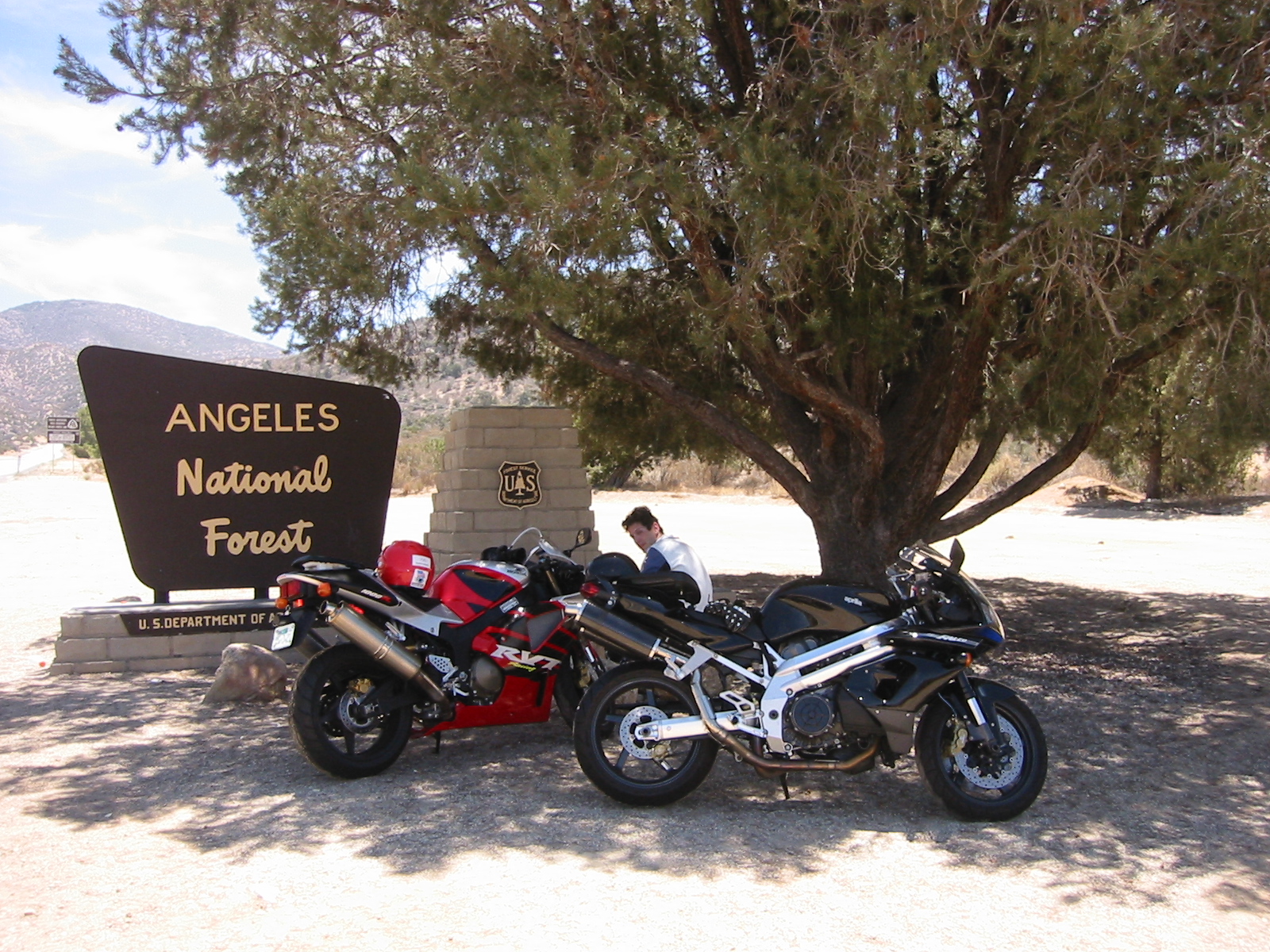
Out on the back of Angels Crest national park I was able really let the bike loose over 350 miles
of made for biker-heaven roads.The improved ride and suspension, with stronger forks and a longer(
and 1.5lblighter) swing arm aligned to small frame stiffness adjustments improving the feedback to
the rider and enabling you to enjoy the bike more fully without fatigue before being forced
to arrest your desires as the limited fuel range forces a number of gas stops.

Honda claims that the new engine mapping has improved the fuel consumption, but they haven’t said
exactly how much. No doubt the 998 Ducati and Aprilia Mille (my wing man for the day) run just as
fast and also further on  tank of gas. But although the Italians may have staked a firm
claim on the V-twin laurels, you know which make you’d rather tour on.

At high speed, and I saw an indicated 165mph (on a closed course) without much bother, the bike is
stable but not totally secure as I swayed noticeable in the slight cross winds, something which the
Hayabusa would not have been affected by. Nevertheless, the new fairing is a vast improvement especially
on the highway, as it creates an impressive bubble for the rider to tuck into.

Stopping is just as simple, the RC51 benefiting from some of the best anchors around. There had been
some concern on the previous model, as under hard deceleration the forks juddered and hopped
which simply couldn’t be dialed out.The SP2 has solved this and allows for even mere amateurs to wipe
off speed in impressive style.

In and around town, I found the throaty and torquey V-twin perfectly suited to my riding style;
smooth, compliant and highly maneuverable. It allows you to ride very swiftly through traffic,
assisted by the narrow profile afforded by the engine lay-out,the handlebars not so cantered to
produce chronic wrist ache, as so often found on “race bikes”. In fact I would say that as
a solution to good town navigation, fast bike credibility and out and out performance the RC51
has few piers and even fewer masters. If, as can only be surmised, this is the result of the factory
racing effort – then once again Henry Ford’s motto is proved correct.Namely that:
“Racing improves the breed”.


MORE INFORMATION:

http://www.hondausa.com

Thanks to:

Arai helmets: http://www:araiamericas.com

Intersport Clothing: 1 800 416 8255.  http://www:intersportfashions.com


      SPECIFICATIONS

      Model: 2002 RVT1000R
      Suggested Retail Price: $10,999
      Engine Type: 999cc liquid-cooled 90-degree V-twin
      Bore and Stroke: 100.0mm x 63.6mm
      Compression Ratio: 10.8:1
      Valve Train: DOHC; four valves per cylinder
      Carburetion: PGM-FI with two injectors per cylinder
      Ignition: Computer-controlled digital with three-dimensional mapping
      Transmission: Close-ratio six-speed
      Final Drive: #530 O-ring-sealed chain
      Front Suspension: 43mm inverted HMAS™ cartridge fork with spring-preload,
      rebound and compression-damping adjustability; 5.1-inch travel
      Rear Suspension: HMAS Pro-Link® single shock with spring-preload, rebound
      and compression-damping adjustability; 4.7-inch travel
      Front Brakes: Dual full-floating 320mm discs with four-piston calipers
      Rear Brake: Single 220mm disc with single-piston caliper
      Front Tire: 120/70ZR-17 radial
      Rear Tire: 190/50ZR-17 radial
      Wheelbase: 55.9 inches
      Rake (Caster Angle): 23.5 degrees
      Trail: 94.6mm (3.7 inches)
      Seat Height: 32.3 inches
      Dry Weight: 430.0 pounds
      Fuel Capacity: 4.8 gallons, including 1.2-gallon reserve
      Color: Red/Metallic Silver